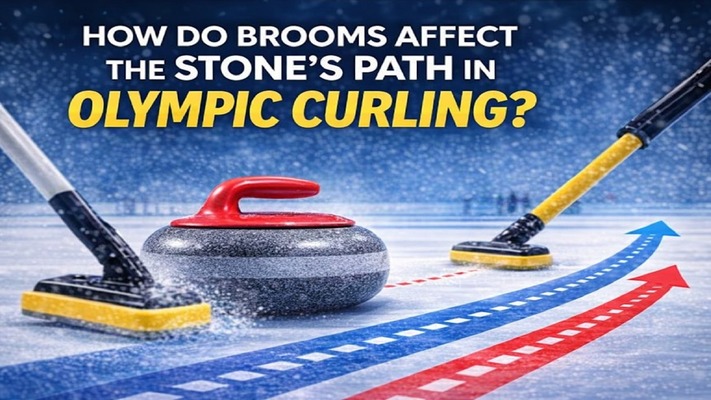
Olympic curling may appear simple at first glance, but every shot depends on precision, teamwork, and a deep understanding of ice conditions. One of the most fascinating aspects of the sport is sweeping, a technique that can dramatically influence the movement of the stone after it leaves the player’s hand. Many new fans often ask, “how do brushes affect the stone’s path in olympic curling?“ The answer lies in a combination of physics, strategy, and split-second communication among teammates.
Far from being a decorative part of the game, curling brushes help athletes control speed, distance, and direction. Skilled sweepers can transform an average shot into a winning one by making subtle adjustments as the stone travels down the sheet.
Understanding the Basics of Curling
Curling is played on a long sheet of ice where teams slide heavy granite stones toward a target area known as the house. Each team consists of four players who take turns delivering stones while teammates sweep the ice in front of the moving stone.
A curling stone naturally follows a curved path because players apply a slight rotation, known as the handle, when releasing it. This curve is called the curl. Without sweeping, the stone slows down more quickly and curls more sharply as it moves across the pebbled ice surface.
The objective is to control both the speed and the amount of curl so the stone finishes in the desired position.
The Science Behind Curling Brushes
To understand how do brushes affect the stone’s path in olympic curling?, it is important to examine what happens at the ice surface.
Curling ice is not perfectly smooth. Officials create tiny droplets of frozen water, called pebbles, across the sheet before play begins. These raised bumps reduce the contact area between the stone and the ice.
When players sweep vigorously with their brushes, they generate friction and slightly warm the surface of the pebbles. Although the temperature change is minimal, it reduces resistance enough to affect the stone’s movement.
Sweeping creates two major effects:
- It allows the stone to travel farther.
- It decreases the amount of curl.
As a result, players gain more control over the final position of the stone.
How Sweeping Changes the Stone’s Direction
Many spectators believe sweepers physically push the stone with their brushes. In reality, sweepers never touch the stone itself.
Instead, they modify the ice directly in front of it. Reduced friction means the stone loses less speed, allowing it to continue moving straighter for a longer period.
If players sweep intensely, the stone curls less and follows a wider, flatter trajectory. When they stop sweeping, the stone begins to slow down and curl more sharply toward the center of its natural path.
This ability to influence movement explains why teams constantly communicate during each shot. The skip, who stands near the target area, watches the line and tells teammates when to sweep harder, ease off, or stop entirely.
The Importance of Timing and Communication
Knowing how do brushes affect the stone’s path in olympic curling? involves more than understanding friction. Success depends on perfect timing.
Sweep too early, and players may cause the stone to travel too far. Sweep too late, and the stone may already have curled beyond the intended line.
Elite curlers make decisions within seconds based on several factors, including:
Ice Conditions
Temperature, humidity, and the quality of the pebbled surface can influence how a stone behaves during a match.
Stone Speed
A faster stone requires less sweeping because it naturally travels farther before slowing down.
Shot Type
Different shots demand different sweeping strategies. Draw shots, guards, takeouts, and freezes all require unique approaches.
Team Communication
Sweepers constantly provide feedback about the stone’s speed while the skip evaluates its direction. Effective communication helps teams make rapid adjustments.
At the Olympic level, this coordination separates medal contenders from the rest of the field.
Modern Brush Technology and Regulations
Brush design has evolved significantly over the years. Early curling brushes featured simple corn brooms, but modern equipment uses advanced synthetic materials.
Several years ago, concerns emerged that certain brush fabrics gave teams too much control over stone movement. Some materials could scratch the ice surface and alter a stone’s direction more than intended.
As a result, governing bodies introduced strict regulations regarding brush head materials and construction. Today’s approved brushes ensure that skill, technique, and strategy determine the outcome rather than technological advantages.
These regulations maintain competitive fairness while preserving the traditional spirit of curling.
Why Sweeping Matters So Much in Olympic Competition
The difference between victory and defeat in Olympic curling often comes down to a few centimeters. Understanding how do brushes affect the stone’s path in olympic curling? reveals why sweeping is one of the sport’s most valuable skills.
A well-executed sweep can save an underthrown stone, reduce excessive curl, or place a stone perfectly behind a guard. Conversely, poor sweeping decisions can ruin an otherwise excellent delivery.
Every player on the ice contributes to each shot, making curling one of the most collaborative sports in the Olympic Games.
Conclusion
So, how do brushes affect the stone’s path in olympic curling? Brushes influence the stone by reducing friction on the pebbled ice surface, allowing it to travel farther and curl less. Sweepers do not push the stone directly; instead, they carefully manage the conditions in front of it.
Successful sweeping requires strength, timing, communication, and a strong understanding of ice behavior. When viewers watch Olympic curlers sweep furiously alongside a moving stone, they witness a precise blend of science and teamwork in action.
The next time you watch a curling match, pay close attention to the sweepers. Their decisions can change the outcome of a shot and, in many cases, determine the result of the entire game.